
Handbag Brand Commercialization
A handbag pre-order strategy can do much more than generate early sales. Used correctly, it becomes a commercial validation system: a way to test real buying intent, refine your first production quantity, protect cash flow and make better manufacturing decisions before committing to bulk inventory.
For a new handbag brand, one of the most expensive assumptions is believing that a finished sample automatically proves there is a market for the product.
It does not.
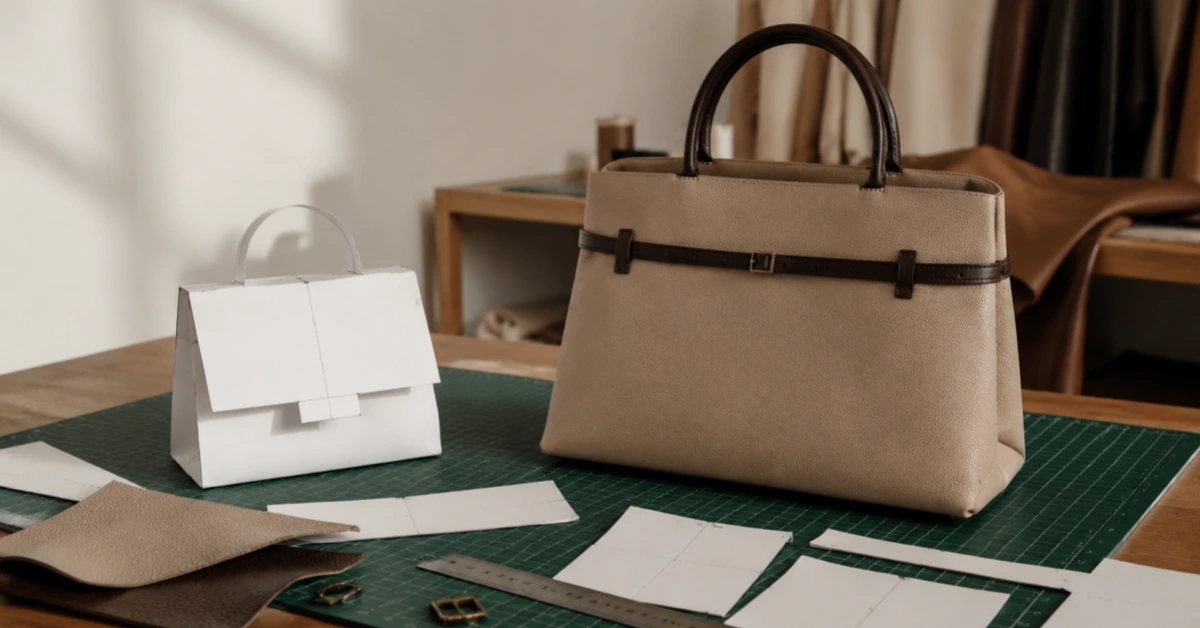
A successful sample proves that a design can be translated into a physical product. It can confirm proportion, construction, material compatibility, hardware functionality, craftsmanship and production feasibility. But it does not prove that enough customers will buy the bag at the price required to build a profitable business.
That gap between product validation and market validation is where many first handbag collections become risky. The founder approves a sample, places a bulk order based mainly on confidence or enthusiasm, and only after inventory arrives discovers whether the market agrees.
A well-designed handbag pre-order strategy changes the sequence. Instead of using bulk production as the first serious market test, the brand uses a production-ready sample, strong launch assets and a controlled pre-sale period to collect evidence before making the largest inventory commitment.
Sample → Market Test → Pre-Order Data → First-Order Planning → Bulk Production → Reorder
This does not mean every handbag startup should run a large crowdfunding campaign or refuse to hold inventory. It means the brand should create a deliberate validation stage between product development and bulk manufacturing.
Shopify itself identifies demand forecasting as one of the reasons merchants use pre-orders for new products. Its official guidance also makes clear that pre-orders involve real fulfillment and customer communication responsibilities, not merely a marketing countdown. Shopify Pre-Orders Documentation.
Why Bulk Production Should Not Be Your First Market Test
The first bulk order is usually where a new handbag brand takes on several risks at the same time: production deposits, material commitments, packaging, freight, duties, warehousing, launch spending and unsold inventory. These risks are manageable when the order size is supported by evidence. They become much more dangerous when the order is based only on opinions.
Friends saying they like a design is not validation. Social-media likes are not validation. A waitlist can be useful, but it is still weaker than a paid order. Even high engagement on a campaign does not automatically show that customers accept your final retail price.
The strongest signal is usually commercial intent: a customer is willing to exchange money for the product under clearly stated delivery conditions.
This matters because fashion businesses are highly exposed to inventory decisions. McKinsey has repeatedly highlighted inventory management as a profitability issue for fashion companies, with excess stock creating pressure through warehousing, discounting and markdowns. A demand-led first-order strategy is therefore not simply conservative; it is a way to preserve margin and working capital. McKinsey: The State of Fashion 2025.
The purpose is to replace part of the uncertainty with measurable customer behavior before the brand commits to larger inventory.
What a Handbag Pre-Order Strategy Can Actually Validate
A useful pre-sale handbag campaign should answer more than one question. “Did we get orders?” is only the beginning. The most valuable pre-order data helps a founder understand several layers of the business model.
1. Whether customers will pay the intended retail price
Price acceptance is more valuable than general product interest. A bag may receive strong reactions at $120 and almost no conversion at $240. If the business model requires a $240 retail price to support landed cost, marketing and operating margin, then the lower-price enthusiasm is not sufficient validation.
This is why pre-order testing should happen after the brand has at least a preliminary understanding of factory cost, packaging, freight, duties, payment fees and expected acquisition costs. If the commercial price has not been modeled, the pre-order can validate the wrong proposition.
2. Which colorways deserve inventory
New brands often create too many colors because color expansion feels less risky than developing an entirely new silhouette. Operationally, however, every additional color can split demand, complicate material purchasing and create slow-moving stock.
Pre-order demand can reveal whether one color is the clear hero, whether two colors are commercially viable or whether several variants are attracting attention but not purchases.
That information can directly influence the production allocation rather than forcing the factory and founder to guess an equal split.
3. Which product message is working
Customers rarely buy only a silhouette. They buy a proposition. One audience may respond to craftsmanship, another to function, another to a distinctive hardware story, another to travel practicality or a particular styling identity.
During a controlled handbag pre-sale, the founder can compare which product-page messages, campaign visuals and creator content generate actual checkout behavior. The goal is not endless A/B testing. The goal is to identify which explanation of the product converts interest into purchase.
4. Whether the expected demand is large enough for the manufacturing model
A design can be attractive and still be commercially unsuitable for a particular production structure. This often appears when a bag needs custom hardware, uncommon materials, special molds or complex workmanship that creates a higher practical MOQ or cost threshold.
Pre-order demand should therefore be evaluated against the actual manufacturing economics, not only against a marketing target.
If a design receives 35 paid orders but the feasible production setup requires 300 units, the signal is different from 35 paid orders for a product that can be produced economically at 100 units.
Do Not Start Pre-Orders Too Early
Pre-orders reduce some forms of uncertainty, but they can create a different problem when the product is not mature enough. Selling a concept before the design, construction, materials and production route are reasonably stable can result in missed delivery dates, cost surprises or a final product that differs from what the customer expected.
For most new handbag brands, the safer sequence is:
- Define the target customer and product proposition.
- Develop the first sample.
- Correct structure, proportion, hardware and material issues.
- Approve a near-final or production-ready sample.
- Confirm preliminary factory cost and MOQ.
- Estimate packaging, freight, duties and other landed-cost components.
- Create accurate photography, video and product-page content from the approved product.
- Open a controlled pre-order window.
- Use the resulting demand data to plan the first bulk order.
Bagsrain treats this as part of handbag product validation, not as a separate marketing trick. The commercial test only becomes useful when the product being marketed is close enough to the product that can actually be manufactured.
If your product is still changing substantially, review our custom handbag product development guide before treating market feedback as a signal for production.
What Must Be Known Before You Open a Handbag Pre-Sale?
A pre-order page creates an expectation of future delivery. Therefore, a brand should not launch simply because it has attractive renders or a first prototype.
At minimum, the founder should have reasonable visibility into the following:
- Final product direction: silhouette, dimensions, construction and key functional details should be substantially confirmed.
- Material direction: leather, textile, lining, reinforcement and trims should have realistic sourcing paths.
- Hardware feasibility: custom molds, plating, logo treatment and lead times should be understood.
- MOQ: the brand should know the practical minimum for the product, material and color structure.
- Preliminary unit cost: the founder should know whether the intended selling price can support the business.
- Production lead time: the factory should provide a realistic range based on the approved development direction.
- Packaging plan: dust bags, boxes, inserts, labels and shipping cartons should not be an afterthought.
- Quality standard: important cosmetic and functional acceptance points should be defined before mass production.
- Fulfillment communication: customers must understand that the product is a pre-order and when shipment is expected.
How Many Pre-Orders Are Enough to Justify Bulk Production?
There is no universal number.
A handbag brand should not copy another founder's threshold because the correct decision depends on MOQ, contribution margin, fixed development costs, expected organic demand, paid acquisition, cash reserves and the amount of inventory the brand can carry without damaging operations.
A more useful starting point is a pre-order coverage ratio.
Example: 60 confirmed pre-orders against a planned first run of 150 units = 40% pre-order coverage.
This ratio does not tell you automatically whether to produce. It tells you how much of the initial inventory commitment is already supported by direct demand.
A founder can then evaluate the uncovered quantity:
The real question becomes: can the brand reasonably sell the uncovered inventory within its planned selling window without relying on destructive discounting?
Use three decision layers, not one number
Demand Signal
How many customers paid? Which colorways converted? Was demand concentrated or evenly distributed?
Unit Economics
After landed cost, payment fees, fulfillment and customer acquisition, is there enough contribution margin?
Inventory Capacity
Can the company finance and hold the uncommitted units if sell-through is slower than expected?
The first production run should be the intersection of these three realities, not simply the factory's MOQ and not simply the number of people who joined a waitlist.
Do Not Produce Exactly the Number of Pre-Orders
If 80 customers pre-order, producing exactly 80 units may appear capital-efficient, but it can leave the brand unable to support launch momentum.
A first production plan may also need units for:
- customer exchanges or defect replacement;
- post-launch website inventory;
- creator, stylist or press seeding;
- photography and campaign use;
- retail or pop-up testing;
- quality-control retention samples;
- unexpected demand after launch.
The correct first order is therefore normally a combination of committed demand + operational buffer + planned launch inventory.
This is where pre-orders become a production-planning tool instead of merely a cash-generation tactic.
The next decision is how much additional stock to produce beyond the paid demand. That deserves its own inventory model; see our guide on strategic handbag line and demand-led production planning.
A Pre-Order Is Not Automatically Profitable
Early revenue can create false confidence if the price structure is weak.
Imagine a bag has a factory cost of $55 and is pre-sold for $150. At first glance, the spread appears healthy. But factory cost is not landed cost, and landed cost is not the total cost of selling the product.
The commercial model may also include:
- packaging;
- freight and import duties;
- payment processing;
- warehousing and fulfillment;
- returns and replacement allowance;
- content production;
- influencer seeding;
- paid acquisition;
- discounting or promotional buffer;
- overhead and future product-development costs.
A pre-order campaign that works only because the launch price is too low can validate demand while simultaneously invalidating the business model.
Before using pre-orders to decide production volume, founders should understand the difference between factory quotation and commercial cost. Our article How Much Does It Cost to Manufacture a Handbag? explains the manufacturing side of that equation.
Should You Offer a Pre-Order Discount?
A discount can accelerate early adoption, but it should have a strategic reason. If the only way to generate demand is a very large discount, the campaign may be measuring bargain sensitivity rather than product-market fit.
Instead of automatically using a deep discount, a handbag brand can test value through:
- limited founder pricing;
- early access rather than permanent discounting;
- limited first-edition colors;
- complimentary personalization;
- special packaging;
- priority shipment;
- small deposits where the selling platform and local rules support them.
The closer the pre-order price is to the sustainable long-term retail price, the more useful the demand signal becomes.
What If the Pre-Order Campaign Underperforms?
A weak pre-order is not automatically a failed brand. It is information arriving before the most expensive decision.
The founder should diagnose the result rather than jumping directly to bulk production or abandoning the idea.
Scenario 1: High traffic, low add-to-cart rate
This may indicate a problem with positioning, product presentation, audience fit or price perception. Review the hero image, product benefit hierarchy, dimensions, material explanation, styling context and trust signals.
Scenario 2: Strong add-to-cart, weak checkout completion
Investigate shipping cost, delivery timing, payment options, taxes, checkout friction and customer uncertainty around the pre-order promise.
Scenario 3: One color converts, the others do not
Do not force an equal production split simply because all colors were part of the original design concept. The purpose of validation is to let demand influence allocation.
Scenario 4: Customers like the product but resist the price
The wrong response is automatically to cut price. First determine whether the problem is value communication, the target audience or the actual cost structure. If the product cannot support a profitable price, the design or sourcing model may need adjustment.
Scenario 5: Demand exists but is below MOQ
This is a manufacturing-commercial mismatch. Possible responses include simplifying customization, reducing color fragmentation, changing materials, postponing custom hardware, negotiating a development path toward the target MOQ or running a longer validation window.
Discovering a problem before bulk production gives the brand the opportunity to change the product, offer, price or quantity while the cost of correction is still relatively low.
Pre-Order Data Should Change Your Manufacturing Plan
Collecting pre-order data is pointless if production decisions remain unchanged.
The manufacturer should receive a clearer commercial brief after the validation period:
- confirmed quantity by color;
- planned additional inventory by color;
- final packaging quantities;
- priority delivery timing;
- any product changes triggered by market feedback;
- quality points that customers repeatedly asked about;
- forecast for possible reorder timing.
This is one reason Bagsrain positions product development as a path from validation to repeat growth rather than treating the sample as the end of the project.
The production partner does not need to run the brand's marketing campaign. But manufacturing decisions should reflect what the brand learned from the market.
From Pre-Order Validation to the First Bulk Order
Once the brand has collected meaningful demand data, the objective changes. The question is no longer “Do people like this bag?” It becomes “What is the most rational first production plan given the evidence we now have?”
A practical decision framework is:
- Confirm paid demand. Separate actual orders from email signups, likes and survey responses.
- Calculate the demand mix. Identify the real color, size and configuration split.
- Recheck margin. Make sure the validated selling price still supports landed cost and go-to-market expenses.
- Compare demand with MOQ. Determine where manufacturing constraints and market demand align or conflict.
- Set additional launch inventory. Decide how much stock beyond pre-orders can reasonably sell without relying on heavy markdowns.
- Add an operational buffer. Plan for exchanges, replacements, QC and campaign needs.
- Lock production specifications. Do not keep changing the product after orders have been taken unless the change is necessary and clearly communicated.
- Prepare the reorder trigger. Define in advance when strong sell-through will justify the next production run.
Pre-Orders Work Best as Part of a Larger Commercialization System
Pre-orders are useful, but they are only one stage in turning a handbag idea into a repeatable business.
Bagsrain's recommended commercial path is:
Validate Demand → Plan the First Order → Protect Margin → Launch → Measure Sell-Through → Reorder → Expand the Collection
That sequence matters because every stage creates information for the next one.
Product development provides the sample. The sample provides real content. The content helps generate pre-order demand. Pre-order demand improves the first production plan. Sales data improves the reorder. Reorder data reveals whether the product deserves color expansion, a related silhouette or a wider collection.
This is how a new handbag brand can move from product development to commercial validation and then to repeatable growth without treating every production run as a new guess.
When Pre-Orders Are Not the Right Strategy
Pre-orders should not be treated as a universal solution.
They may be unsuitable when:
- the sample is still far from the final product;
- material availability is highly uncertain;
- production timing cannot be estimated responsibly;
- the brand cannot communicate delivery changes professionally;
- the product depends on untested tooling or complex engineering;
- the expected customer strongly values immediate delivery;
- the company lacks enough cash to complete production even after receiving pre-order revenue.
In these cases, a waitlist, deposit-free reservation, private customer test or smaller pilot batch may produce better information with less fulfillment risk.
The Real Goal: Make the First Bulk Order an Evidence-Based Decision
The strategic value of a handbag pre-order is not that customers pay before inventory arrives. The value is that the brand learns before it scales.
A strong pre-order strategy can help answer:
- Is the customer willing to pay the intended price?
- Which color should receive the largest production allocation?
- How much of the first production run is already supported by real demand?
- How much additional inventory can the business responsibly carry?
- Does the current margin structure support growth?
- What should trigger the first reorder?
That is a much more valuable outcome than simply collecting early revenue.
For a founder, the objective is not to remove all uncertainty before production. That is impossible. The objective is to make the largest commitments only after the most important uncertainties have been reduced.
In other words:
Use development to prove the product can be made, pre-order validation to test whether customers will buy it, and first-order planning to decide how much inventory the business should actually carry.
Planning Your First Handbag Production Run?
Bagsrain works with handbag brands from product feasibility and sampling through first-order planning and repeat production. If you already have a concept, sample, tech pack or early pre-sale data, we can review the product from a manufacturing and launch-readiness perspective before you commit to bulk production.
Request a Development ReviewExternal references: Shopify Help Center — Pre-orders · Shopify Help Center — Setting up pre-orders · McKinsey — The State of Fashion 2025