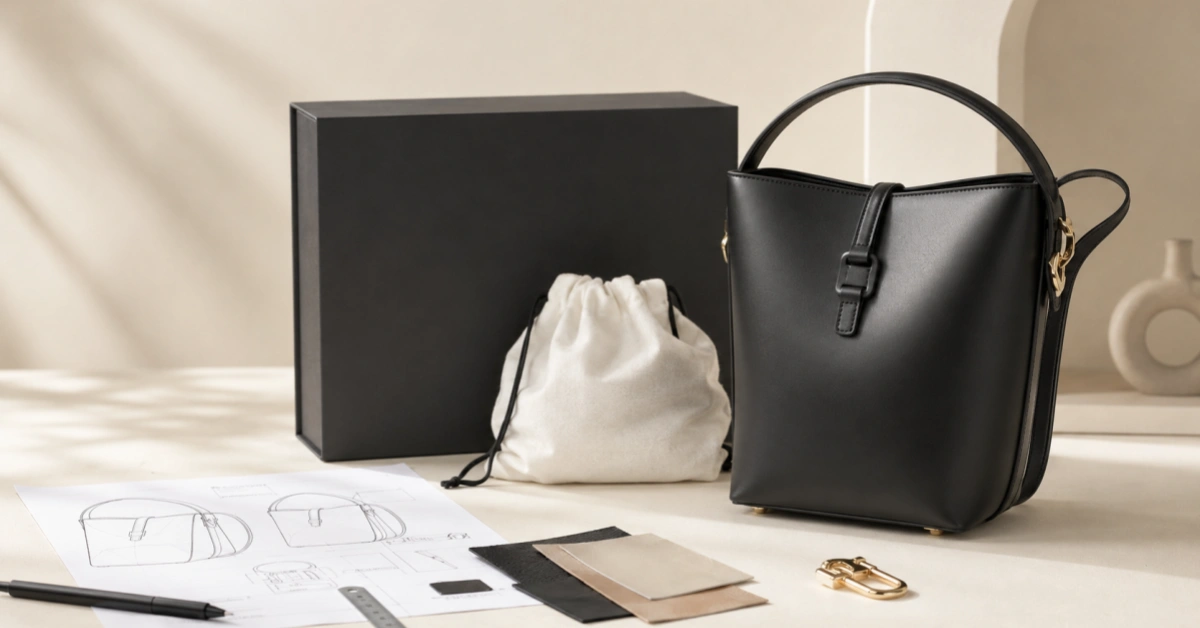

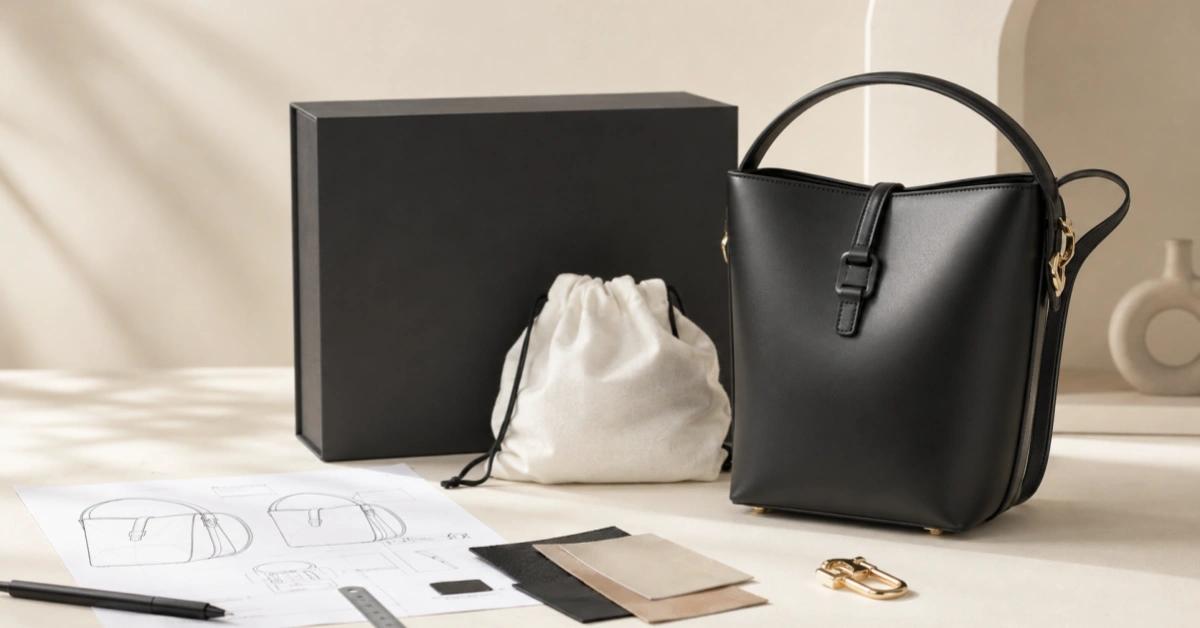
A handbag can look finished long before it is truly ready for manufacturing. A sketch may communicate the right silhouette, a reference sample may capture the intended feeling, and a material swatch may offer exactly the color and texture the designer wants. Even the first physical prototype can look impressive when placed on a table.
But none of these things alone prove that the product is ready for production.
The difficult part of custom handbag product development is not simply turning a drawing into a physical bag. It is turning that design into a product that can be manufactured consistently, at the right cost, with the right materials and components, across an actual commercial production order.
For an emerging brand, a poorly resolved design can consume a large part of the development budget through repeated sampling.For an established brand, the same problem can become much more expensive: inconsistent hardware, delayed materials, unacceptable color variation, weak strap construction, packaging problems, or a sample that cannot be reproduced reliably across hundreds or thousands of pieces.
A capable custom bag manufacturer therefore needs to do more than sew what appears in a drawing.The manufacturer needs to understand how design, material, structure, hardware, workmanship, cost, production tolerance, quality control, and future repeat orders affect one another.
This guide explains how professional handbag development moves from an early concept to a production-ready product, what should be validated before sampling, what brands should evaluate during prototype development, and how decisions made at the beginning influence first production and future collection growth.
Why a Good Handbag Design Is Not Automatically Production-Ready
Designers naturally begin with the customer experience. They think about silhouette, proportion, color, texture, function, and visual identity.
Manufacturing begins from another perspective.
The production team needs to understand whether the selected material can hold the intended shape, whether the top edge will remain stable after repeated use, whether the handle attachment can support the expected load, and whether a zipper can follow a curved opening without rippling. They also need to consider whether custom hardware requires reinforcement, whether the leather thickness is suitable for the edge construction, and whether the required color can be reproduced consistently during larger material purchases.
Another important question is whether the construction can be repeated by different operators without creating unacceptable variation.
A factory may be able to make one beautiful sample through careful manual adjustment. That does not automatically mean the same construction is suitable for mass production.
Production requires repeatability.
If every corner needs to be corrected manually, if each hardware component fits slightly differently, or if small material thickness variations change the finished dimensions, those details can quickly become quality problems when the project moves beyond one prototype.
The real development question is therefore not simply, “Can this bag be made?” It is, “Can this bag be produced repeatedly, consistently, at the required quality and commercial cost?”
That is the difference between simple sample making and serious handbag product development.
Start With Product Validation, Not Immediate Sampling
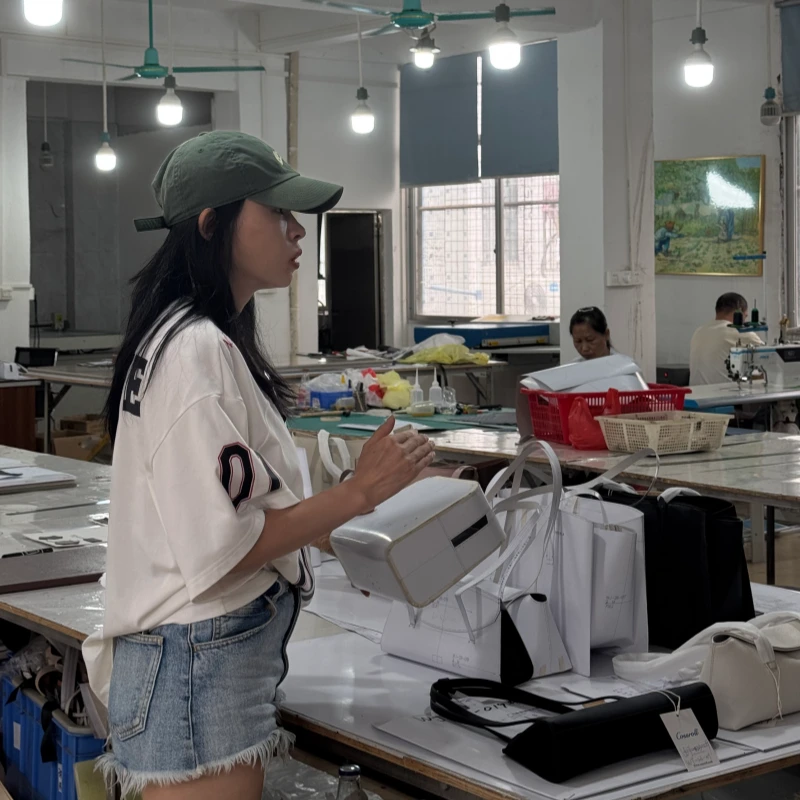
One of the most common mistakes in custom bag development is entering the sampling stage before enough product decisions have been made.
A customer sends a sketch, the manufacturer gives a sample quotation, materials are selected quickly, and a prototype is produced. Only after the sample arrives do both sides discover that the structure is too soft, the hardware is too heavy, the dimensions need to change, or the expected production cost is significantly higher than originally planned.
At that point, the development process moves backward.
A more efficient approach begins with a development review.
Before making the first sample, the manufacturer should understand the intended customer, product positioning, function, dimensions, material direction, hardware requirements, expected quantity, and target manufacturing range.
A small evening bag and a laptop tote may both use leather, but their internal engineering requirements are completely different.A large tote carrying significant weight may require reinforced handle attachment areas and a more stable base, while a small fashion bag may place greater emphasis on precise proportions, hardware scale, and surface finishing.
Retail positioning also influences development decisions earlier than many brands expect.A contemporary handbag, a premium leather product, and a volume-driven fashion accessory may require different materials, packaging, workmanship, and cost structures.
The earlier these questions are resolved, the more valuable the first sample becomes.
Translate the Design Into a Manufacturing Structure
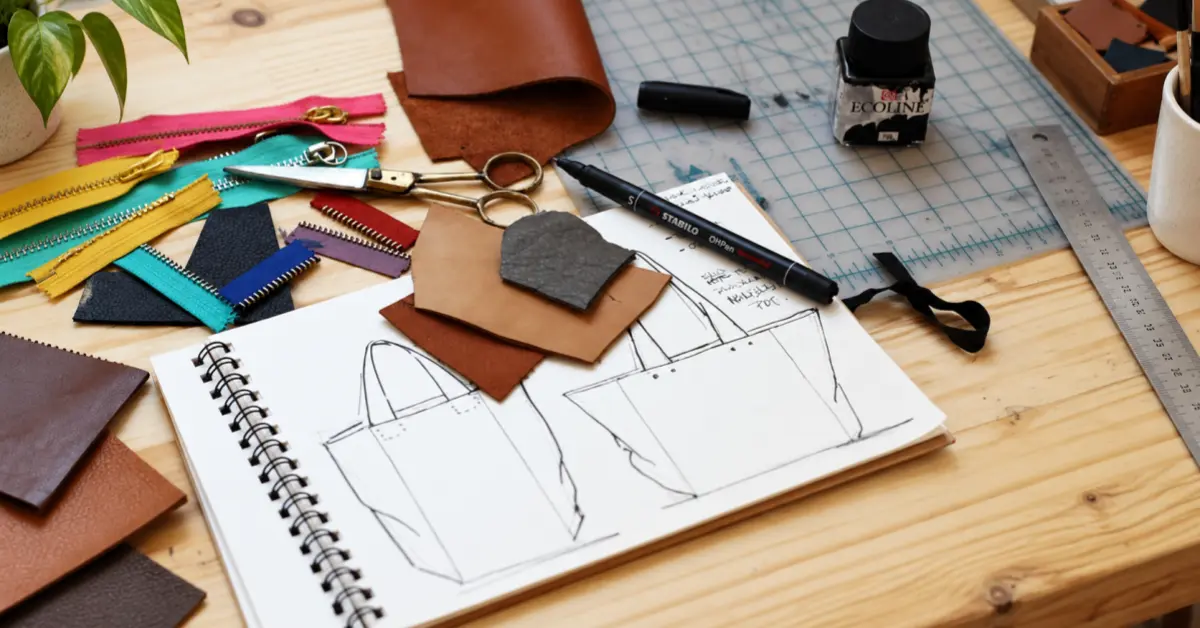
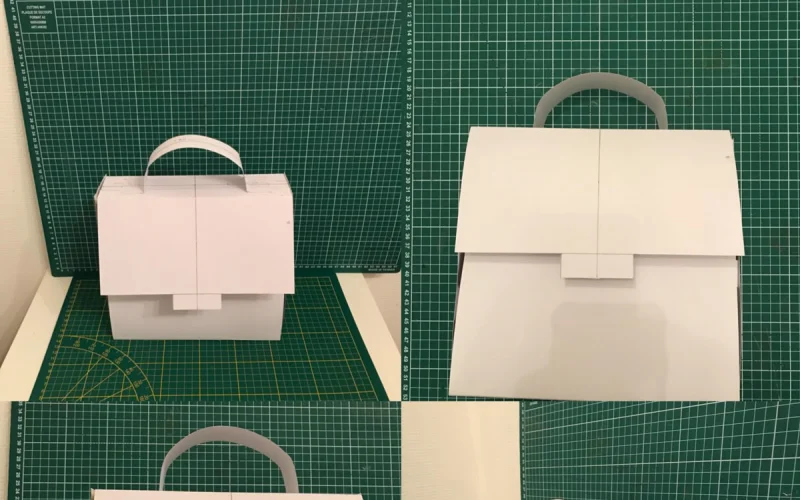
A handbag drawing mainly communicates appearance. A manufacturer must convert that appearance into actual layers, components, seams, reinforcements, and assembly processes.
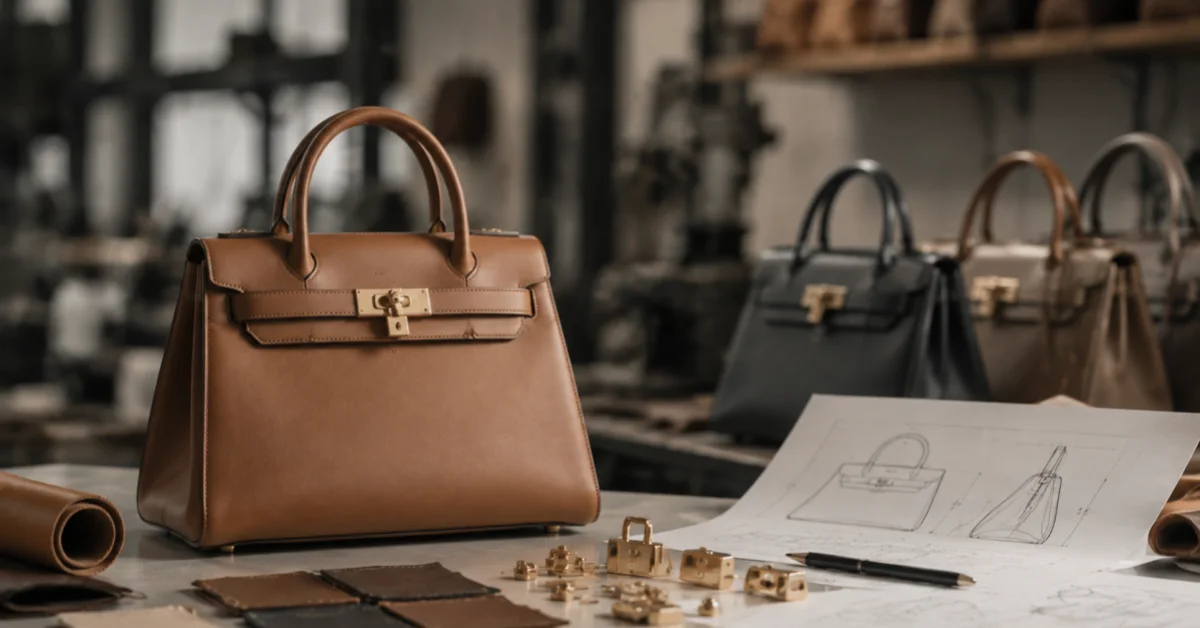
Consider a structured top-handle handbag.From the outside, the design may appear relatively clean and simple. Internally, however, it can contain exterior leather, backing materials, reinforcement, lining, base boards, piping, edge paint, zipper tape, handle cores, metal rings, attachment plates, feet, internal pockets, and branded hardware.
Every component influences the finished product.
This translation stage is where an experienced custom handbag manufacturer can create significant value. The goal is not to change the designer's idea unnecessarily, but to identify how that idea can be constructed reliably.
For example, a soft hobo bag may need reinforcement around the opening so that it does not collapse excessively, but too much reinforcement would destroy the intended relaxed shape. A large tote may require hidden structural support behind its handles so that carrying weight is distributed over a larger area. A structured flap bag may need reinforcement behind a turn-lock to prevent the front panel from deforming after repeated use.
Similarly, a curved zipper opening may require pattern adjustment so the zipper remains smooth, while a bag with a heavy chain strap may need stronger attachment areas than the same design using a leather strap.
These details are rarely visible in fashion sketches.They emerge only when the design is interpreted as a physical product.
Material Selection Should Follow Structure, Not Just Appearance
Material is one of the most important decisions in handbag development, yet it is often discussed too narrowly.
Brands frequently begin with descriptions such as “soft black leather,” “dark brown suede,” or “premium vegan leather.” These references are helpful, but color and surface appearance alone do not determine whether a material is suitable.
A material needs to work with the structure of the bag.
Imagine two handbags made with visually similar leather. One is a relaxed shoulder bag designed to drape naturally. The other is a highly structured top-handle bag with precise edges and stable geometry. The same leather may perform beautifully on the first product and poorly on the second.
This is because handbag materials vary in thickness, softness, stretch, grain, surface treatment, backing, recovery, folding behavior, edge performance, and color consistency.
A material that is too soft can cause a structured bag to lose its intended form. A material that is too thick can create bulky seams around narrow corners.Some materials accept edge paint easily, while others require more preparation.Certain surfaces show pressure marks or scratches more easily, and suede introduces additional considerations such as nap direction, cutting consistency, and color variation.
Alternative materials also behave differently depending on their backing structure and surface treatment.
For this reason, handbag material sourcing should be part of product engineering rather than a separate visual selection exercise. The goal is not simply to locate the material that looks closest to a reference image.The goal is to choose a material capable of producing the intended product consistently.
Hardware Is Part of the Engineering
Hardware is often treated as decoration, but in handbag manufacturing it can be both an aesthetic element and a structural component.
A lock determines how a flap closes. A ring transfers load between the strap and the bag body. Feet affect how the base contacts a surface. A chain changes the weight distribution of the product. A zipper influences both opening function and panel construction.
This means hardware should be considered early in the development process.
Standard components can simplify development when suitable shapes, sizes, and finishes already exist. Custom hardware provides more control over product identity, but it can also require dimensional drawings, 3D development, mold creation, prototype casting, polishing, plating, color approval, fit testing, and production tolerance checks.
This becomes particularly important when multiple metal components must match one another.
A handbag may contain a buckle, zipper pull, chain, feet, rings, hooks, and a logo plate.If those parts come from different suppliers or use different plating processes, the final “gold” tone may vary visibly.
For premium product development, those parts should be evaluated as a system rather than approved individually.
Weight also matters. A large metal lock may look excellent in a rendering but cause the front of a soft leather bag to collapse. A heavy chain can alter how the bag hangs on the body. Oversized metal rings may distort thin leather around the attachment area.
The solution may involve changing hardware thickness, reducing weight, adding hidden reinforcement, adjusting dimensions, or modifying the surrounding construction.
This is another example of why handbag development cannot be divided into isolated design choices. Materials, hardware, structure, and function interact constantly.
Handbag Prototype Development Should Test Decisions
The first prototype is where assumptions become physical.
This makes handbag prototype development one of the most valuable stages of the entire project.
A useful sample should answer practical questions.Does the silhouette match the design? Does the bag hold the intended shape? Is the opening comfortable to use? Is the strap length correct? Does the hardware feel proportionate? Is the finished bag heavier than expected? Do the pockets function correctly? Does the zipper operate smoothly? Does the material crease in unwanted areas?
The sample should also reveal how the bag behaves when carried rather than simply how it looks when photographed.
For highly customized products, the first sample is rarely the final approval sample.
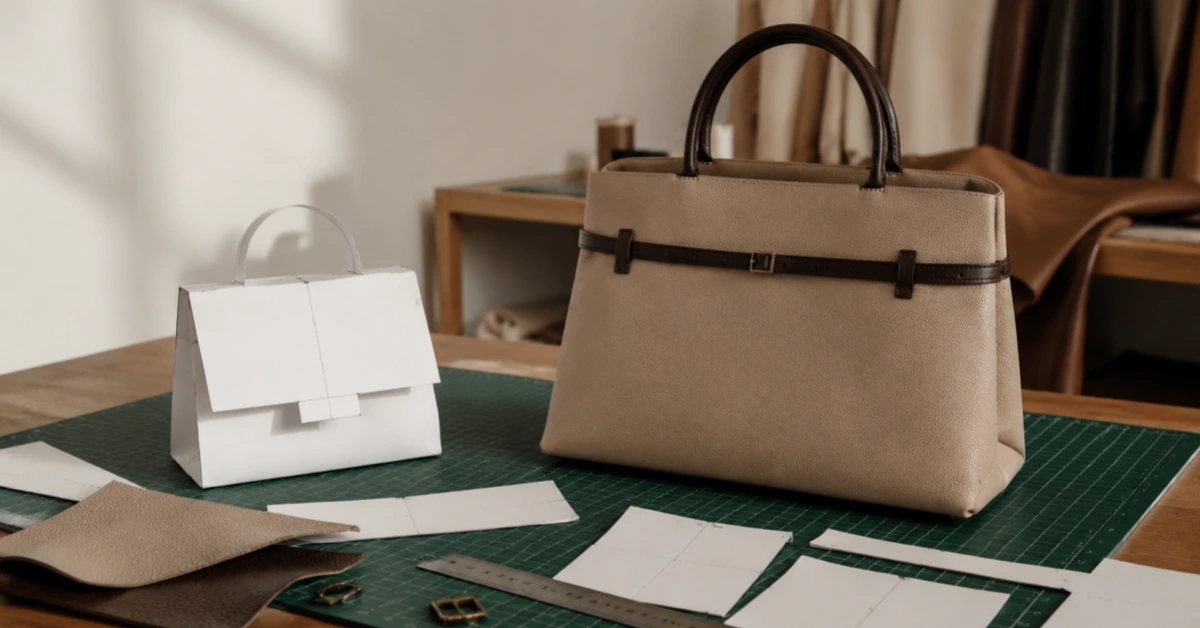
A first prototype may primarily validate dimensions, proportions, construction, pattern, and material direction.The next version can then refine reinforcement, hardware, edge finishing, internal organization, strap structure, and final detailing.
Trying to solve every variable simultaneously often makes development harder to evaluate. If several major changes are made at once, it becomes difficult to identify which change actually improved or harmed the product.
A disciplined sampling process records revisions and gradually converts approved decisions into production specifications.
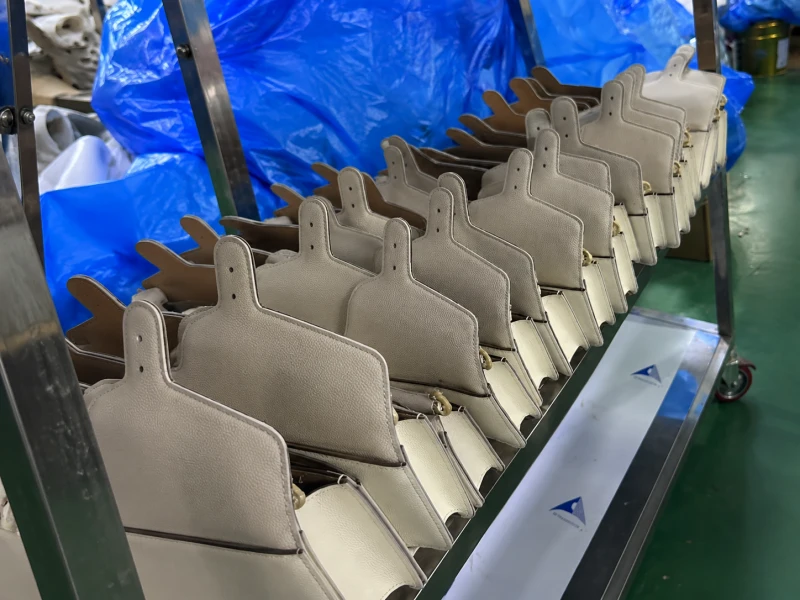
How to Review a Custom Handbag Sample Properly
A handbag sample should not be approved simply because it looks attractive.
It should be reviewed systematically.
Start by comparing the physical sample with the approved drawing, rendering, or measurement sheet. Review overall width, height, depth, handle drop, strap length, opening width, pocket position, and hardware scale.
Not every small dimensional difference is equally important.A few millimeters may have little effect in one area but significantly change the visual proportion of another.
The objective is controlled conformity to the intended design.
The bag should also be tested both empty and loaded. This is particularly important for functional products. A tote may look perfect when empty but deform after carrying weight. A shoulder bag may hang differently once a phone, wallet, and other everyday items are placed inside.
Closures, zippers, hooks, adjustable straps, pockets, and handles should all be tested through actual use. High-stress areas such as handle attachments, strap anchors, zipper ends, flap hinges, bottom corners, and hardware mounting points deserve particular attention.
A handbag is not a display object. It is a functional product.
Cost Engineering Should Happen During Development
Manufacturing cost should not become a surprise after the final sample is finished.
The cost of a custom handbag is influenced by far more than the choice between genuine leather and synthetic material.It also depends on material consumption, cutting efficiency, number of panels, construction complexity, lining, reinforcement, hardware quantity, custom molds, plating, edge painting, stitching, manual finishing, packaging, and order quantity.
A simple-looking handbag can sometimes be expensive because its construction requires significant labor.Conversely, a more detailed-looking product can sometimes be optimized without noticeably changing its identity.
Good cost engineering does not mean automatically reducing quality.
The purpose is to identify inefficient complexity.
For example, an internal construction may be simplified without changing the exterior appearance. Two reinforcement layers may be replaced with one more appropriate material. Standard components may be used where custom development adds little customer value.Better pattern planning can reduce leather waste, and packaging dimensions can sometimes be optimized to reduce shipping volume without reducing presentation quality.
These changes can make a product more commercially viable while preserving its intended positioning.
MOQ Should Be Discussed as a Production Question
Brands often begin supplier conversations by asking, “What is your MOQ?”
It is an important question, but the answer depends heavily on the product.
Minimum order quantity can be influenced by material purchasing requirements, custom colors, hardware production minimums, molds, packaging, number of styles, and the number of color variations.
For this reason, the lowest possible MOQ is not always the best production strategy.
For example, dividing a relatively small first order across too many colors can create inefficient material usage, fragmented component purchasing, and greater production complexity.
A stronger first-order strategy may be to concentrate volume around fewer validated colorways and use the initial production run to evaluate market response.
Small batch handbag manufacturing works best when the product itself has been planned for small-batch production, rather than forcing a highly complex development into an artificially low order quantity.
Sample Approval Is the Beginning of Production Preparation
When the final sample is approved, one stage ends and another begins.
The approved sample now needs to become a reproducible manufacturing standard.
Before production, the brand and manufacturer should confirm final measurements, material specifications, lining, hardware, plating color, stitching, edge finishing, logo placement, packaging, labels, and critical construction details.
This is also the stage when unnecessary changes should stop.
A seemingly small change such as increasing strap length, changing leather thickness, moving an interior pocket, or switching zipper specifications can affect patterns, consumption, components, manufacturing sequence, cost, or timing.
The purpose of final approval is to freeze enough variables that production can be controlled.
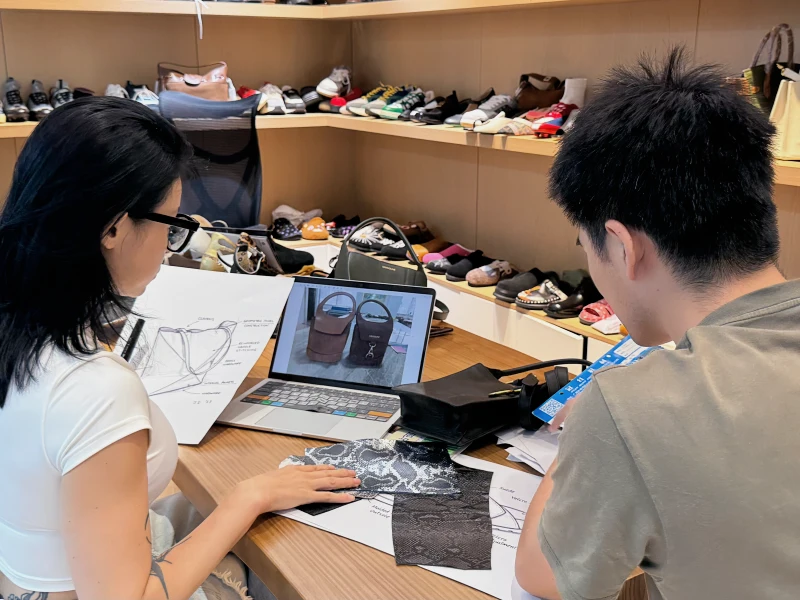
The First Production Order Is a Commercial Validation Stage
The first production order is different from both sampling and repeat production.
Sampling proves that the product can be made once.
The first commercial order proves that it can be made repeatedly.
This transition is particularly important because the manufacturing environment changes significantly when one sample becomes hundreds of bags.
Materials are purchased in larger quantities. Multiple cutters and sewing operators may work on the order. Hardware is produced as a batch. Edge finishing and assembly are repeated many times. Packaging also becomes an operational process rather than a one-off presentation detail.
Small variations that were invisible in one prototype can become recurring patterns during mass production.
This is why a custom handbag manufacturer needs clearly defined production standards before batch manufacturing begins.
Handbag Quality Control Should Be Built Into Production
Final inspection is important, but quality cannot be created only at the end of production.
If the wrong material has already been cut, final inspection cannot efficiently solve the problem. If hardware plating is inconsistent, discovering the issue after assembly creates unnecessary waste. If an incorrect seam position continues for several days, checking only finished products means the defect has already multiplied.
Effective handbag quality control should therefore begin with incoming materials and components and continue throughout production.
Materials may need to be checked for color, thickness, texture, surface defects, usable area, and batch consistency. Hardware can be inspected for dimensions, plating, scratches, functionality, and attachment fit. In-process inspection can focus on stitching, positioning, symmetry, reinforcement, edge preparation, and construction accuracy.
Finished products can then be evaluated for measurements, appearance, function, workmanship, cleanliness, hardware condition, and packaging.
The most effective quality system prevents problems from moving into the next manufacturing stage.
A Production-Ready Bag Should Also Be Repeat-Order Ready
One of the least discussed aspects of handbag product development is continuity.
A brand may spend months perfecting a product and return six months later to place a repeat order.
At that point, several questions become important. Can the same leather still be sourced? Is the hardware finish documented clearly? Is the final edge paint color recorded? Were the last pattern changes saved? Can the new order match the previous production?
This is where disciplined documentation creates long-term value.
A well-developed handbag should not only be ready for one production order. It should also be ready for replenishment, new colors, seasonal versions, alternative materials, size extensions, and related silhouettes.
For a growing brand, repeatability becomes an asset.
The first product can eventually become the foundation of a larger collection.
Scaling From One Handbag to a Collection
Once a product performs well, brands often want to expand it.
A successful tote may develop into a smaller tote, shoulder bag, crossbody version, wallet, or travel product. A distinctive lock may become a recognizable feature across several silhouettes. A successful leather quality may be extended into additional colors.
This is where a long-term manufacturing relationship becomes increasingly valuable.
The manufacturer already understands the brand's preferred materials, hardware finishes, quality expectations, construction language, packaging, target cost, and approval standards.
Development does not disappear, but accumulated product knowledge reduces unnecessary repetition.
This is one reason established brands often evaluate suppliers not only by unit price, but also by their ability to maintain quality and support continuous product development.
Common Mistakes Brands Make During Custom Bag Development
Several development mistakes appear repeatedly.
One is selecting a manufacturer only by the lowest quotation. Two quotations may represent very different products if the suppliers are using different material qualities, reinforcement methods, hardware specifications, or finishing standards.
Another mistake is treating reference images as complete specifications. A photograph can communicate style, but it rarely explains dimensions, internal construction, material thickness, hardware function, or quality requirements.
Brands should also avoid changing too many variables during the same sample round. If the material, pattern, hardware, dimensions, and internal structure all change simultaneously, evaluating the next sample becomes much more difficult.
Material should never be selected by color alone. Two materials can look almost identical but behave very differently during cutting, sewing, edge finishing, and long-term use.
Hardware should not be left until the end of development either. Custom components can influence mold cost, development timing, MOQ, product structure, and weight.
Most importantly, samples should be tested through actual use, and development should consider what happens after the first production order rather than treating each manufacturing stage as an isolated transaction.
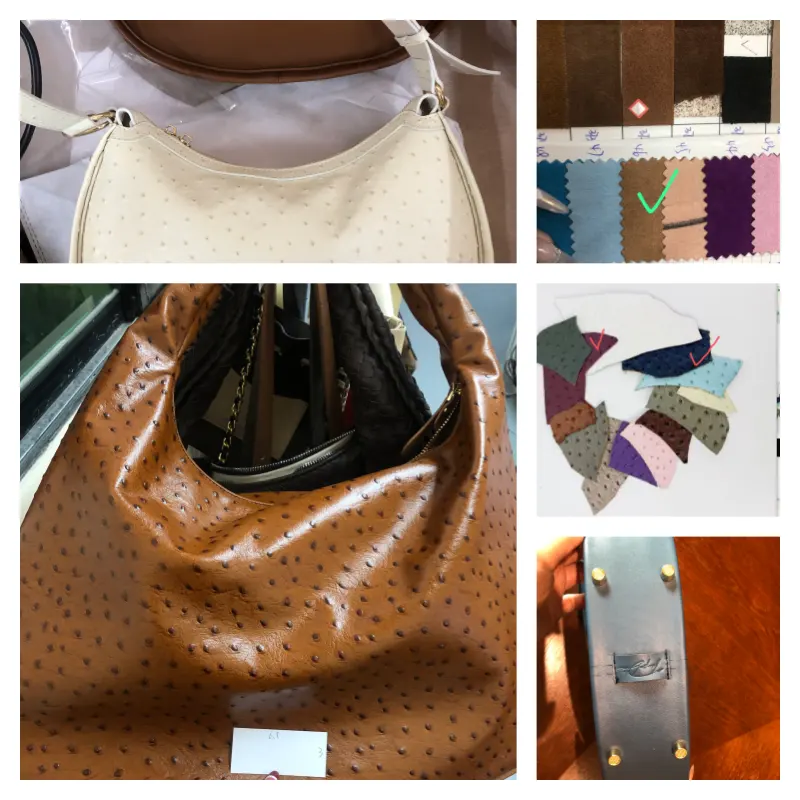
What Should You Send a Custom Bag Manufacturer?
The clearer the starting information, the more productive the development process becomes.
Brands do not always need a complete professional tech pack before contacting a manufacturer. Useful starting information may include sketches, drawings, reference images, dimensions, target materials, colors, hardware references, logo artwork, internal organization requirements, expected quantity, target market, price positioning, and planned launch timing.
If some information is still unknown, it is better to identify that clearly than to make premature decisions.
A capable product development team should be able to help determine which specifications need to be confirmed before sampling and which can be refined during development.
The objective is not to make the brand perform the manufacturer's technical work. The objective is to create enough clarity for both sides to make better development decisions.
How to Evaluate a Custom Handbag Manufacturer
Factory size alone does not determine whether a supplier is suitable for a development-intensive project.
A more useful evaluation looks at how the manufacturer approaches problems.
Does the supplier immediately quote from a photograph, or do they first ask about dimensions, materials, structure, function, and expected order quantity? Do they understand why different materials behave differently in specific constructions? Can they explain how custom hardware is developed and controlled? Do they have experience with products that use similar construction methods?
Sampling processes are equally important. Brands should understand how revisions are recorded, what each prototype is intended to validate, and how the approved sample becomes the final production standard.
Quality should also be discussed before production rather than after a defect occurs.
Finally, brands should think beyond the initial order.If the product performs well, can the manufacturer support new colors, repeat production, packaging updates, and future collection development?
The best manufacturing partner is not always the supplier that says yes the fastest. It is often the one that identifies potential problems before those problems become expensive.
The Bagsrain Approach: Validate, Launch, Scale
At Bagsrain, we view custom bag manufacturing as a connected product development process rather than a series of isolated transactions.
During the Validate stage, the objective is to understand whether the design can be manufactured in a way that preserves its intended appearance, function, quality, and commercial positioning. Materials, structure, hardware, dimensions, workmanship, cost, and production feasibility all need to work together.
During the Launch stage, the approved prototype is converted into a controlled first production order. Material standards, hardware specifications, packaging, workmanship, inspection requirements, and manufacturing details need to be clearly established.
During the Scale stage, the focus expands to repeat orders, color extensions, new materials, related silhouettes, packaging improvements, and more efficient production planning.
The objective is not simply to manufacture a handbag from a drawing. It is to connect design intention with manufacturing reality.
From One Good Sample to a Reliable Product
The difference between a sample maker and a long-term manufacturing partner becomes clearer as a brand grows.
Making one attractive handbag is valuable, but building a repeatable product system around that handbag is more valuable.
That system connects design specifications, material standards, hardware standards, construction methods, sample approval, production control, quality inspection, and repeat manufacturing.
When these elements are connected properly, product development becomes more predictable. Problems are identified earlier, revisions are easier to evaluate, production standards become clearer, and repeat orders become easier to manage.
New products can also benefit from knowledge created during previous development cycles.
For brands, this is the real value of working with an experienced custom bag manufacturer. The objective is not simply to receive a quotation or a sample. It is to develop a product that can successfully move from an idea into a repeatable commercial manufacturing program.
Frequently Asked Questions About Custom Handbag Product Development
How do I start developing a custom handbag?
Start by organizing the information that defines the product, including sketches or reference images, approximate dimensions, intended function, material direction, hardware ideas, expected order quantity, and target market. You do not always need a finished tech pack before contacting a manufacturer. Early communication can help determine which specifications need to be developed before the first prototype.
Do I need a tech pack before contacting a custom bag manufacturer?
Not necessarily. A detailed tech pack can improve efficiency, especially for established brands, but a manufacturer can also begin from sketches, drawings, mood boards, reference samples, or early design concepts. The important thing is to distinguish between confirmed requirements and areas that still need development.
How many samples are required before handbag production?
There is no universal number. A straightforward product using existing materials and hardware may require fewer revisions than a highly customized handbag with new structure, custom molds, special materials, and complex finishing.The objective should be to resolve meaningful product questions rather than aim for a fixed number of sample rounds.
What affects the cost of custom handbag manufacturing?
Manufacturing cost is influenced by material, material consumption, construction complexity, hardware, custom molds, lining, reinforcement, edge finishing, stitching, manual operations, packaging, and order quantity. Two handbags with similar dimensions can therefore have very different production costs.
Can a manufacturer develop custom handbag hardware?
Yes, depending on the manufacturer's capabilities and supplier network. Custom locks, buckles, rings, zipper pulls, logo plates, feet, chains, and decorative metal components can often be developed from drawings or design references. Custom hardware usually requires additional consideration for dimensions, molds, plating, MOQ, fit, durability, and production consistency.
What is the MOQ for custom handbags?
MOQ depends on the product and its supply chain. Material purchasing minimums, custom colors, hardware, molds, packaging, and the number of variations can all influence feasible production quantities. Brands should evaluate not only total MOQ, but also how that quantity is distributed across different styles and colors.
How should I approve a handbag sample?
Review more than appearance. Check dimensions, proportion, material, structure, hardware, stitching, edge finishing, internal organization, closures, strap length, balance, and performance during actual use. The final approved sample should represent a product that both the brand and manufacturer understand clearly enough to reproduce consistently.
What happens after a handbag sample is approved?
The project moves into production preparation. Final materials, hardware, colors, measurements, construction details, packaging, labels, and quality standards should be confirmed before mass production begins. Changes after final approval should be controlled carefully because even small adjustments can affect cost, timing, or manufacturing.
How can I maintain quality between the sample and mass production?
Quality consistency depends on clear specifications, approved materials, approved components, in-process inspection, production controls, and final inspection. The approved sample is important, but it should be supported by documented standards rather than acting as the only source of information.
Can a custom bag manufacturer support repeat orders and new collections?
A long-term manufacturing partner should be able to support repeat production, new colors, alternative materials, additional sizes, related silhouettes, packaging updates, and future product development. Accurate product records become increasingly important as the brand and collection grow.
Start With the Product, Not Just the Quote
If you are developing a new handbag collection, the most useful first conversation is rarely just about price.
A reliable quotation depends on understanding what the product actually needs to become.
Start with the design, understand the structure, select materials that work with that structure, resolve the hardware, and use sampling to test real product decisions.Once the product is validated, the next step is building a production process that can reproduce it consistently.
At Bagsrain, we help brands move through this process from early product evaluation and prototype development to first production and future collection growth.
Ready to Develop Your Handbag?
Have a handbag concept, sketch, reference product, or existing design you want to develop? Request a Development Review to discuss the material, structure, hardware, sampling, and production path for your project.
Request a Development Review