
Deciding where to anchor your supply chain is perhaps the most consequential decision a fashion founder will make. In the post-2025 landscape, the debate of American vs. Chinese handbag manufacturers has moved beyond simple labor costs. It is now a complex calculation of Risk-Adjusted Lead Times, Material Provenance, and ESG (Environmental, Social, and Governance) Compliance.
At Xinzirain, we’ve spent over a decade bridging the gap between high-end design aspirations and technical manufacturing reality. This guide provides a transparent, data-driven look at which region suits your brand’s current stage.
The "Made in USA" Appeal: Why Brands Choose Domestic Production
For many emerging designers in New York, Los Angeles, or London, domestic manufacturing feels like the "safer" choice.
Pros: Marketing and Speed
-
The "Made in USA" Halo: For brands targeting a patriotic or ultra-luxury niche, this label allows for a significant price markup. Consumers often perceive domestic goods as more ethical or artisanal.
-
Agile Prototyping: Being in the same time zone means you can jump on a call—or a flight—to resolve a stitching issue in hours rather than days. This "Rapid Iteration" is vital for brands doing weekly drops or limited editions.
-
No Import Duties: You avoid the complexity of Section 301 tariffs and customs brokerage fees.
Cons: The Scalability Bottleneck
While great for starting, US-based production often hits a Capacity Ceiling. Many domestic workshops lack the specialized machinery for complex internal structures or high-volume hardware customization. Additionally, the Unit Economics can be prohibitive for brands looking to achieve a 5x-7x retail markup.
Why High-End Brands are Scaling with Xinzirain (China)
The "China Manufacturing" narrative has evolved from mass-market replicas to High-Tech Precision. Leading brands are no longer moving to China just to save money—they are moving there for Capability.
The Ecosystem Advantage
In manufacturing hubs like Guangzhou, the entire supply chain is interconnected. At Xinzirain, we provide:
-
Unrivaled Material Sourcing: Access to LWG (Leather Working Group) Gold-rated tanneries and innovative bio-materials (like cactus or apple leather) that are often unavailable or triple the price in the West.
-
Vertical Integration: We don't just sew bags. We offer custom hardware molding, specialized CNC cutting, and integrated shoe-and-bag collection development.
-
Scalable Unit Economics: As shown in the industry "Quick Verdict," China is the clear winner for brands scaling from 500 to 5,000+ units.
The "Hidden" Tech: 3D Sampling
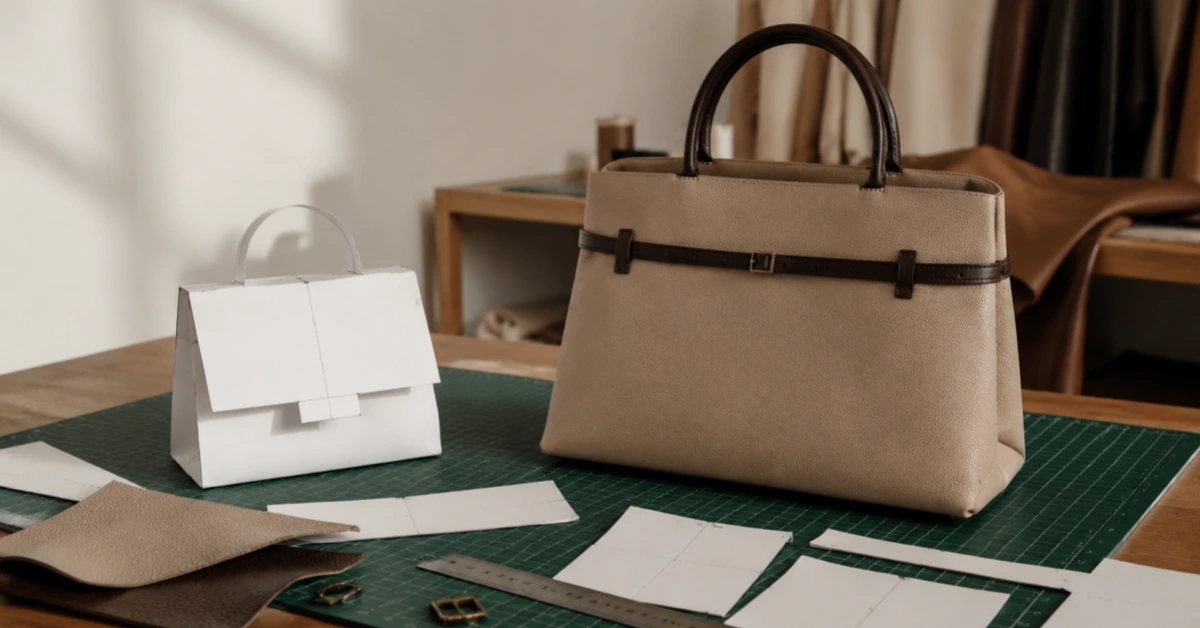
Western brands are increasingly looking for Digital-First Manufacturers. Xinzirain utilizes 3D rendering and digital pattern-making to reduce physical waste and speed up the "Design-to-Sample" phase by up to 40%.
Financial Deep Dive: Total Landed Cost (TLC) Explained
A common mistake for new brands is comparing "Unit Cost" instead of "Landed Cost." To rank for high-intent B2B keywords, we must address the math.
The TLC Equation:
In 2026, even with a 25% tariff, a handbag produced at Xinzirain often arrives at a US warehouse with a 35-50% lower TLC than a domestically produced equivalent. This margin is the difference between a brand that survives its first year and one that thrives.
Addressing the "Ethics & Transparency" Gap
European and American consumers now demand Social Proof. A major pain point in "overseas" production is the fear of poor working conditions or environmental damage.
Xinzirain’s Response to Western Standards:
-
Transparency: We provide virtual factory tours and real-time production updates.
-
Sustainability: We prioritize GRS-certified recycled linings and vegetable-tanned leathers.
-
Certification: Our facilities adhere to international labor standards, ensuring your brand stays compliant with the growing "Green Claims" legislation in the EU and the US.
Risk-Adjusted Lead Time: The 2026 Competitive Edge
The image provided highlights a critical term: Risk-Adjusted Lead Time. In the world of "Shipageddon" and global port delays, "time" is a variable, not a constant.
-
US Lead Times: Usually 4-8 weeks, but often delayed by labor shortages.
-
Xinzirain Lead Times: 30-45 days for production, plus 12 days for air freight or 30 days for sea.
The Xinzirain Strategy: We mitigate "Risk-Adjusted" delays by offering DDP (Delivered Duty Paid) shipping. We handle the customs, the taxes, and the last-mile delivery, so your "China experience" feels as seamless as ordering from a local vendor.
Case Study: Small Batch vs. Mass Market
| Feature | The Boutique Designer (USA/EU) | The Scaling Brand (Xinzirain) |
| Initial MOQ | 10 - 50 units | 50 - 100 units |
| Material Variety | Limited to local stock | Infinite (Customized) |
| Unit Margin | 30% - 45% | 60% - 75% |
| Best For | Proof of Concept | Global Market Expansion |
How to Transition from "Local" to "Global" Manufacturing
If you have been manufacturing in the USA but find that your margins are shrinking, transitioning to a partner like Xinzirain is a 3-step process designed for Western brands:
-
Technical Pack Audit: Send us your current US-made sample. We will perform a "Cost-Benefit Analysis" to see where we can improve durability and reduce costs.
-
The Hybrid Sample Phase: We produce a counter-sample to prove our quality matches (or exceeds) your current domestic production.
-
Phased Scaling: Start with 100 units to test the logistics before moving your entire core collection.
Final Verdict: Where Should You Produce in 2026?
The "Quick Verdict" remains true: China is the winner for brands prioritizing scalable unit economics. However, the "New China" represented by Xinzirain offers something the old factories didn't: Empathy for the Designer. We understand that for a Western brand, a bag is not just a product—it's a reputation.
By choosing Xinzirain, you get the Agility of a US workshop with the Industrial Power of a Global Leader.
Conclusion: Let’s Build Your Next Collection Together
The gap between American and Chinese manufacturing is closing in quality but widening in value. Don't let high domestic costs or limited material options stifle your brand’s creativity.
Ready to see the Xinzirain difference?
-
Consultation: Book a free 20-minute strategy call with our production managers.
-
The Unit Cost Worksheet: Get a transparent quote that includes shipping and duties to your door.
-
Sample Gallery: Browse our latest 2026 material swatches, from vegan leathers to luxury calfskin.
Get Started with Xinzirain – Your Bridge to High-End Manufacturing