
Holiday Growth Strategy · For Independent Handbag Brands
A profitable Christmas campaign does not have to begin with “30% off.” For independent handbag brands, the better question is how to make each product feel more giftable, more distinctive and more valuable—without giving away the margin needed to build the next collection.
Christmas is one of the few moments when a customer may purchase a handbag for someone else rather than for themselves. That changes the buying decision. Shoppers care about presentation, certainty, delivery dates, personal meaning and whether the recipient will actually use the gift. A brand that addresses those concerns can compete on value instead of relying on the deepest markdown.
The opportunity begins early. In its October 2025 holiday survey, the National Retail Federation reported that 42% of surveyed shoppers planned to start browsing or buying before November. That is a useful planning signal, not a forecast of what every handbag brand will sell in 2026.
The following twelve Christmas promotion ideas are designed for emerging and premium handbag labels, from a founder running a direct-to-consumer store to a growing brand selling through boutiques. Each idea includes a practical execution angle and a margin or production consideration.
Before you launch: define what your Christmas promotion must achieve
Decide whether you need more first-time customers, a higher average order value, better sell-through on an existing collection or more repeat purchases. These goals require different promotions. A free monogram may increase perceived value but add fulfillment time; a gift set may lift order value but tie up cash in accessories; a limited color may create interest but introduce minimum-order and sampling risks. Effective Christmas marketing for handbag brands begins with a measurable commercial objective, not a promotional calendar copied from larger retailers.
12 Christmas promotion ideas that protect a handbag brand's value
Create a gift-ready edition of your best-selling handbag
Instead of developing a completely new Christmas silhouette, start with a proven shape. Upgrade the dust bag, gift box, tissue wrap or care card. Photograph the complete gift presentation alongside the handbag, so buyers understand exactly what they receive. This is especially effective for brands whose hero bag already has positive reviews and reliable sizing feedback.
Execution: Offer “Gift-Ready Edition” as a clearly priced option or include it above a defined order threshold. Compare the packaging cost with any improvement in conversion or basket value. Avoid claiming “complimentary” if its cost has quietly pushed a product beyond its natural price position.
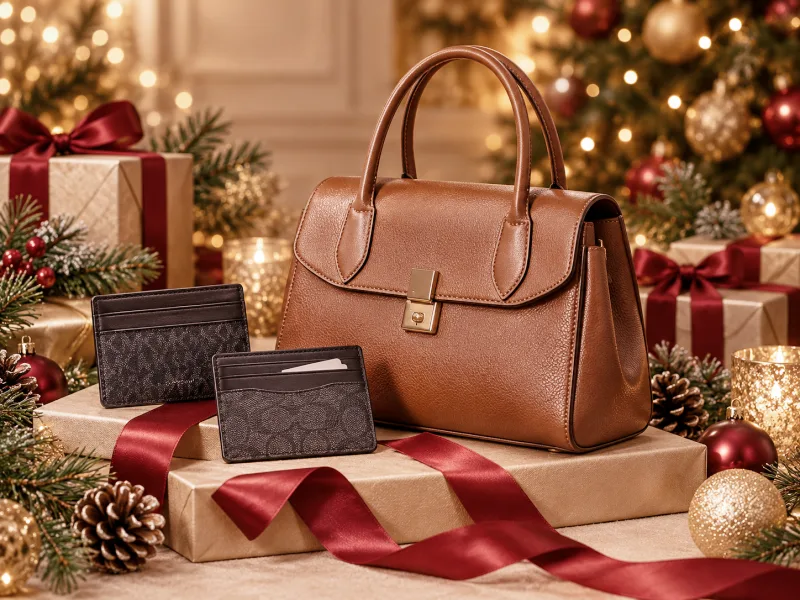
Sell coordinated handbag-and-accessory gift bundles
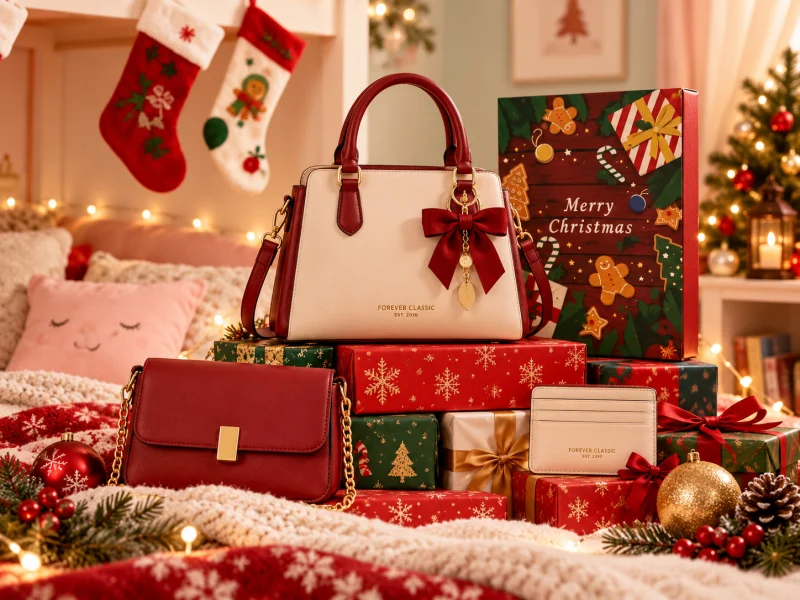
A shoulder bag paired with a matching cardholder, key pouch or mini cosmetic case gives the buyer a complete present and gives your brand a way to increase average order value. The items should look intentional together, not like leftover inventory thrown into a box. Christmas gift bundles work best when each accessory complements the handbag and the combined price still supports a healthy contribution margin.
Execution: Build two or three bundles at different price points. Show the combined individual prices and the bundle price only when the comparison is genuine. Test whether the set sells because it is convenient, visually cohesive or better value. For manufacturing, choose accessories that share materials, colors or hardware wherever practical.
Offer personalization without compromising fulfillment
Initials, a short name or an understated embossed message can make a handbag more meaningful as a Christmas gift. But personalization must be operationally realistic: incorrect spellings, unclear placement and late orders can quickly damage the gifting experience.
Execution: Restrict character count, offer a visual placement guide and publish a firm order cutoff. Test embossing on actual material swatches before accepting orders. For new collections, confirm whether personalization takes place during manufacturing or after stock arrives in your market; these workflows have very different lead times.
Introduce a restrained, limited seasonal color
Deep burgundy, forest green, espresso or warm metallic accents can evoke the holidays without turning a bag into a novelty product. The most commercially useful Christmas collection often retains a silhouette and color palette that customers can wear in January and beyond.
Execution: Start with one proven style and one seasonal color, rather than multiplying sizes, materials and hardware options. Validate the color against your audience's existing purchases. Make an edition “limited” only if a genuine production or sales quantity limit exists.
Give loyal customers early access rather than a broad discount
Existing buyers already know your product quality. Invite them to shop a new color, gift set or small-run design before the public launch. Early access makes the relationship feel valuable while preserving the published price.
Execution: Segment customers by prior purchase, not just mailing-list membership. Send one preview email with clear product photos, a launch time and a specific reason the product is relevant. Measure early-access conversion against your normal returning-customer baseline.
Build a Christmas gift guide around the recipient, not just the product
A buyer shopping for a sister, partner or colleague may not know your bag terminology. “For the minimalist,” “For the frequent traveler,” or “For someone who carries everything” is often more useful than presenting a long grid of shoulder bags and totes. This is an accessible form of holiday handbag marketing: it connects the product to a specific gifting occasion instead of depending on a generic discount message.
Execution: Organize a dedicated landing page by recipient lifestyle, budget and delivery region. Include dimensions, strap drop, interior capacity, materials, returns and shipping deadlines. Link each recommendation to the actual product page, not a generic collection homepage.
Add a thoughtful gift-with-purchase threshold
A well-designed card sleeve, charm or travel pouch can make a purchase feel special. But gifts with purchase are not automatically profitable. A free item should lead to a larger order or improved conversion—not simply reduce earnings on orders that would have happened anyway.
Execution: Select a threshold modestly above your current average order value, then run the numbers. Limit the offer to a defined stock quantity. If using a custom accessory, plan the minimum order quantity and packaging requirements before promising the promotion.
Offer a premium wrapping upgrade at checkout
Some shoppers are buying at the last minute; others are shipping gifts directly to recipients. A carefully presented option for gift wrapping, a printed note and an unbranded shipping carton solves an immediate problem without touching the handbag's retail price.
Execution: Make the upgrade easy to select and clearly describe what is included. Check whether warehouse or fulfillment partners can handle different gift messages accurately, and whether premium packaging changes shipping weight or dimensional charges.
Create a “complete the look” story with your existing products
Christmas marketing can also introduce new customers to your larger design language. Show how a structured mini bag works with an evening outfit, or how an everyday tote pairs with a matching pouch for travel. This promotes the collection as a coherent brand rather than a sequence of isolated SKUs.
Execution: Use a concise editorial shoot across product pages, email and social. Cross-sell accessories where the combination makes sense; avoid distracting customers with recommendations that do not match the original purchase intent.

Use pre-orders carefully for a future or limited-edition release
A pre-order can reveal interest in a design before a large inventory commitment. It is particularly useful when the brand has a recognizable community and can show a credible sample. It should not be used to promise Christmas delivery if sampling, production or freight timelines make that uncertain.
Execution: Clearly label the expected delivery window and refund policy. Separate products available for immediate holiday gifting from items scheduled to ship later. Track actual paid demand, cancellation rates and customer questions. Never treat likes or waitlist signups as equivalent to confirmed orders.
Offer gift cards and post-holiday styling support
A handbag is a personal choice, and recipients may care about dimensions, color or hardware. A gift card reduces guessing for shoppers who want to give from your brand without selecting the exact bag. Post-holiday styling emails or product comparisons can help recipients make an informed purchase.
Execution: Present the gift-card option beside practical product recommendations. Explain redemption conditions clearly and comply with applicable gift-card rules in your selling markets. Send useful product guidance after Christmas rather than a relentless sequence of upsells.
Turn gift purchasers into future brand customers
Not every Christmas shopper is the person who will carry the bag. A care guide, QR code to genuine product instructions or optional product registration can introduce the recipient to your brand. When the gift is well made and easy to use, it can become an introduction to the next collection.
Execution: Add a simple, tasteful care card with relevant materials guidance and a link to support. Seek marketing consent appropriately instead of assuming gift recipients want promotional emails. Track post-holiday visits, repeat purchases and support questions to learn what the gifting experience actually delivered.
Which Christmas promotion should your handbag brand choose?
| Business situation | Best initial test | Main risk to check |
|---|---|---|
| You have a best-selling bag and limited development time | Gift-ready packaging or wrapping upgrade | Packaging lead time and fulfillment accuracy |
| Your average order value is too low | Coordinated handbag-and-accessory sets | Bundle margin and accessory inventory |
| You have a loyal, engaged customer list | Early access or a limited seasonal color | Stock allocation and realistic demand |
| Your shoppers often buy gifts for others | Recipient-based gift guide and gift cards | Choice overload and unclear product information |
| You are considering a brand-new design | Sample validation followed by a transparent pre-order | Delivery promises and cancellation exposure |
A worked example: why a gift set can outperform a price cut
Consider a fictional handbag brand selling one style at $120 with a $42 landed product-and-packaging cost. A 20% discount reduces the retail price to $96 and leaves $54 in gross profit before fulfillment, marketing and other expenses. Now suppose the brand instead offers a coordinated $155 set costing $54. The set generates $101 in gross profit per order—provided shoppers find the combination attractive at that price.
| Illustrative offer | Sales price | Product + packaging cost | Gross profit | Gross margin |
|---|---|---|---|---|
| Standard handbag | $120 | $42 | $78 | 65.0% |
| Handbag at 20% off | $96 | $42 | $54 | 56.3% |
| Handbag + cardholder set | $155 | $54 | $101 | 65.2% |
Illustrative calculations only—not actual Bagsrain customer results. Gross profit = sales price − product and packaging cost. This model excludes transaction fees, freight to customer, returns, marketing, duties and overhead. A higher gross profit per order does not guarantee a higher total profit if the offer converts poorly.
The lesson is not that bundles are always better than discounts. It is that the financial structure of a promotion matters. Compare conversion rate, total contribution profit, average order value and inventory sell-through before choosing a winner.
A practical Christmas campaign schedule for 2026
For brands reading this in October 2026, the safest near-term opportunities are usually existing inventory, ready-to-ship accessories, gift presentation, email segmentation and stronger product storytelling. A fully new custom bag collection may require longer than the remaining holiday window once sample revisions, material sourcing, bulk production, quality checks and shipping are considered. Adapt these holiday sales strategies to your actual production readiness, shipping cutoffs, and sales channels rather than promising a delivery date you cannot meet.
| Period | Primary action | Decision checkpoint |
|---|---|---|
| Early to mid-October | Audit available inventory; select hero styles and bundle concepts | Are all promised SKUs and packaging physically feasible? |
| Late October | Prepare product images, gift guide, landing page and email list segments | Do product pages answer gifting and delivery questions? |
| November | Launch early access, test set offers, prepare Black Friday messaging | Which offers deliver contribution profit, not just clicks? |
| Early December | Focus on in-stock gift choices and reliable shipping information | Are order cutoffs based on carrier and warehouse realities? |
| After Christmas | Review sell-through, returns, customer feedback and repeat purchases | Which products justify development for the next season? |
A five-point campaign checklist
- Pick one commercial target: Decide whether the campaign is about orders, profitability, new buyers, sell-through or retention.
- Calculate the true economics: Include extras such as wrapping, accessories, fulfillment and shipping incentives.
- Reduce the buyer's uncertainty: Show scale, materials, gift presentation, returns and delivery information.
- Confirm operational readiness: Validate stock, production feasibility, quality, packing accuracy and realistic dispatch cutoffs.
- Measure beyond revenue: Review conversion, contribution profit, basket value, return reasons and customer feedback.
How thoughtful product development supports better holiday marketing
Successful Christmas promotion ideas often begin long before the campaign launches. A brand may want to offer a matching leather cardholder, but cannot reach the target retail price with its current materials. It may plan a premium gift box, then discover that its dimensions substantially increase shipping costs. Or it may choose a seasonal color that looks attractive online but has inconsistent results across production batches.
These are product-development decisions as much as marketing decisions. At Bagsrain, our approach is to help handbag brands assess design, materials, sampling, cost structure and production readiness before scaling a new product concept. That means asking not only whether an idea can be manufactured, but whether it can be manufactured consistently at a price and quantity that supports the intended business model.
Planning a future holiday handbag collection?
Whether you are developing coordinated bag accessories, a premium gift-ready edition or an entirely new handbag line, start by validating the product concept, production quantities and target costs. Bagsrain supports independent brands through product development, sampling and scalable manufacturing planning.
Explore Custom Handbag Development →Share your reference designs, target retail range, expected quantity and intended launch window to begin a practical discussion.
Frequently asked questions
How can a small handbag brand run Christmas promotions without discounting?
Start with gift-ready packaging, clearly priced bundles, loyalty-based early access and a useful recipient-focused gift guide. These offers improve the buying experience without making lower prices the central message.
Are limited-edition Christmas handbags worth developing?
They can be, if the style matches demonstrated customer demand and the quantities are commercially reasonable. For a newer brand, a seasonal version of an existing bestseller can reduce uncertainty compared with an entirely new silhouette.
What is the best Christmas gift bundle for a handbag brand?
The most appropriate bundle depends on the brand's customer and price architecture. A handbag with a coordinating cardholder, pouch or other useful small accessory is often easier to explain than a set of unrelated products. Assess perceived value and contribution profit together.
Is October too late to launch custom Christmas handbags?
It may be too late for a complex design starting from scratch, depending on sampling, material availability, production capacity and the destination market. Marketing existing inventory and already-developed accessories is generally more realistic. For new designs, establish feasibility before making a holiday delivery promise.
What should a handbag brand measure after Christmas?
Review contribution profit, conversion rate, average order value, sell-through, return reasons, shipping performance and subsequent customer engagement. These metrics help identify which concepts deserve repeat production.
The takeaway
The most effective Christmas promotion is not necessarily the loudest one. For a premium or emerging handbag label, meaningful gifting, thoughtful merchandising and reliable fulfillment can create stronger reasons to buy than a blanket markdown. Choose offers your customers will value, validate their economics, and use the learning to shape the next collection.
Sources and further reading